

How to build an ai content workflow that scales and stays accurate
Learn how to design an AI content workflow that scales, protects brand voice, and keeps SEO accuracy high across blogs, landing pages, and more.
TL;DR
A structured ai content workflow turns scattered prompts into a repeatable system that delivers accurate, on brand, SEO ready content at scale for SaaS teams and agencies. It connects strategy, research, drafting, human review, and CMS publishing into governed templates for each content type.
- Anchor every workflow in documented content and SEO strategy with clear topic clusters and goals.
- Centralize brand voice, product facts, and compliance rules so AI always works from trusted inputs.
- Standardize prompts, review loops, and on page SEO tasks, then automate internal linking and CMS handoff.
- Use dedicated workspaces and governance to manage multi brand and multi region operations without diluting identity.
- Measure rankings, traffic, and conversions so prompts and workflows continuously improve.
Once these pieces are in place, AI amplifies experts instead of creating rework, producing publishable content that reliably ranks and converts.
The fastest path from idea to publishable article is a repeatable ai content workflow that ties research, brand rules, and human review into a single process. If your team is scaling content for a SaaS product or agency clients, this guide shows why an ai content workflow matters and what outcomes to expect, not just which tools to try.
Most teams treat AI as a writing toy, then spend hours fixing tone, facts, and SEO. An ai content workflow solves that by turning one off prompts into predictable, measurable output that aligns with strategy, brand voice, and search intent.
Why AI content workflows matter for SaaS and agencies
SaaS and agency teams publish dozens or hundreds of pages each quarter, which exposes gaps in quality, voice, and SEO if you rely on ad hoc generation. An ai content workflow standardizes inputs, enforces checks, and reduces the manual rework that kills scale.
Beyond speed, the value of an ai content workflow is measured in consistency, search performance, and lower cost per publishable asset. For product pages, feature announcements, or enterprise blog series, a structured workflow prevents low quality output from reaching customers or prospects.
- Speed with control, generate drafts faster while preserving brand and accuracy.
- SEO alignment, integrate keyword research and on page structure into every piece.
- Consistent brand voice, centralize guidelines so every writer and AI output matches tone.
- Governance and compliance, add review gates to prevent factual errors on product content.
Those four benefits are why teams invest in an ai content workflow rather than a collection of point tools. When the workflow is well designed, AI amplifies experts instead of replacing them, which leads to content that ranks and converts.
If you want a platform that enforces those rules across teams, explore features that centralize brand workspaces and automate SEO tasks, or start a trial to test a complete ai content workflow in your CMS. See the product features that power SEO content at scale and try a demo to evaluate how a structured workflow performs on your topics, not just in lab prompts. Start your free trial to validate the workflow with real production content.
What is an AI content workflow
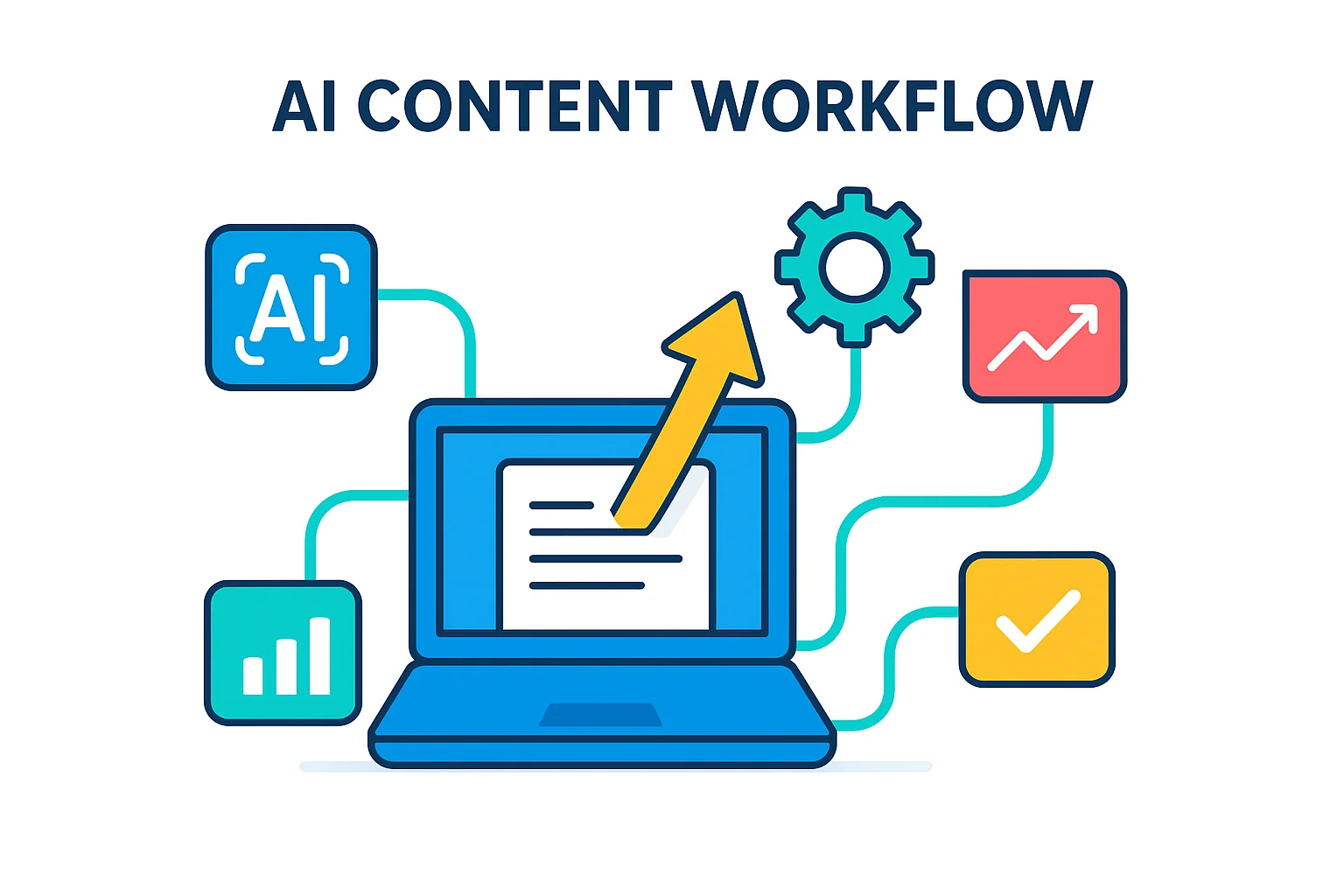
An ai content workflow operates as a repeatable sequence that takes content from idea to publication using AI and humans in defined steps. It connects research, briefs, drafting, editing, SEO, and publishing into one governed process. The goal is predictable, on brand, search aligned content, not random AI outputs.
In practice, your ai content workflow specifies who does what, which tools are used, what inputs AI receives, and what checks must happen before publishing. It can be expressed as an ai content workflow template for each content type, such as blog posts or product pages. Templates reduce variability so teams can move faster without losing control.
This is very different from asking an assistant to “write a blog post about feature X” and hoping for the best. Instead of treating AI as a black box, you design it into each step, from keyword research to internal links, and pair it with human review where judgment or expertise is required.
Even if you use AI content creation free tools for early experimentation, organizing them inside a clear workflow is what turns experiments into an operation. Once the structure is in place, you can swap or upgrade tools without rebuilding your entire process.
Principles of accurate, scalable AI content operations
Accurate, scalable AI content operations rest on a few non negotiable principles. If these are missing, your ai content workflow will generate more editing work than value, and rankings or conversions will suffer. Treat these principles as design constraints, not optional best practices.
First, strategy comes before automation. Every workflow must anchor in real audiences, keyword clusters, and business goals, not just topics that sound interesting. Second, AI should work from trusted inputs: brand guidelines, product docs, and research, not only its own model knowledge.
- Strategy aligned, every workflow ties to a content plan, funnel stage, and keyword cluster.
- Input rich, AI receives brand voice rules, product facts, and source links, not blank prompts.
- SEO first, briefs, outlines, and drafts are built to rank and support content clusters.
- Human in the loop, subject experts and editors review for accuracy and nuance.
- Measured and iterated, performance data shapes future briefs, prompts, and structures.
These principles mirror how advanced teams design AI SEO processes. For example, instead of guessing topics, they use structured AI SEO workflows and tools that generate content that ranks in Google from the start, such as the Factor 6 SEO writer. The result is an operation where AI accelerates experts and scales output without losing rigor.
Step by step: build an AI content workflow that scales
Building an ai content workflow that scales starts with clarifying your goals, then mapping how ideas move from research to published content and measurement. The steps below work whether you are a single SaaS marketing team or an AI content creation agency serving many clients. Start simple, then add sophistication as you see results.
1. Define your content strategy and SEO goals
Begin by documenting who you are writing for, what problems you solve, and how content supports the funnel. Clarify which product lines or services need visibility, and what “good” looks like in terms of rankings, traffic, and conversions. Without this, AI will generate plausible sounding text that is disconnected from outcomes.
Next, build topic clusters and prioritize keywords for each cluster. An ai content workflow works best when it pulls from clearly defined keyword sets rather than improvising topics. Platforms like Factor 6 can generate data driven keyword ideas and clusters so every piece serves a wider search strategy, not just a single query.
Finally, decide how much of this research stage you want to automate today. You might start with AI assisted SERP analysis and competitor breakdowns, then move to full brief generation once you trust the process.
2. Map content types, channels, and ownership
List the core content types you produce: blog posts, thought leadership, product and feature pages, customer stories, lifecycle emails, and social posts. For each type, map where it is published and how it supports the buyer journey. This gives your ai content workflow structure across channels, not just within a single blog stream.
Then define ownership at each stage: strategy, brief creation, AI assisted drafting, subject matter review, editing, SEO review, and publishing. Make it clear who can modify prompts or templates and who signs off on final content. Without these role definitions, AI outputs will circulate without accountability.
3. Centralize brand voice, guidelines, and data inputs
Next, give AI something worthwhile to learn from. Gather your brand voice guidelines, best performing articles, product descriptions, naming conventions, and compliance notes into a single workspace. This is especially important if you manage multiple products or brands under one roof.
In a platform like Factor 6, this looks like brand workspaces that capture tone of voice, messaging pillars, and banned phrases in one place, supported by features such as always on brand content controls. Your ai content workflow should always reference this workspace so outputs stay consistent across writers and campaigns.
Also, define required data inputs for sensitive content types. For example, product pages must pull from a single source of truth such as a product spec sheet or internal wiki. This lowers the risk of hallucinated features or outdated claims.
4. Design prompts, workflows, and human review loops
With strategy and inputs in place, design prompt patterns for each content type. Instead of writing fresh instructions every time, build a reusable ai content workflow template that covers objective, audience, tone, structure, and required SEO elements. This template becomes the backbone of your workflow for that asset type.
Wrap each template in a concrete workflow: who triggers generation, where drafts are stored, who reviews for accuracy, and how edits are captured. Include separate review stages for factual accuracy, brand voice, and SEO. This is where human expertise sits, and where content marketing managers and SEO specialists protect quality.
Finally, define rules for when AI drafts must be heavily revised versus lightly edited. For example, thought leadership may require more human rewriting than a simple feature announcement, even within the same ai content workflow.
5. Automate keyword research and on page SEO tasks
Once workflows exist, start layering in AI content automation for SEO tasks. Use AI to assist with SERP analysis, search intent classification, and outline suggestions that align with target keywords and related queries. This keeps your team focused on angles and expertise instead of manual data collection.
From there, automate repetitive on page tasks: generating meta titles and descriptions, checking heading structures, and proposing internal link opportunities. Factor 6 can, for example, suggest internal links automatically using its automated internal linking feature, so every new article strengthens your content clusters without manual mapping.
Keep SEO checks in the workflow even if AI handles most of the work. Someone on the SEO or content team should still verify search intent match, competitive differentiation, and link strategy before publishing.
6. Connect your AI content workflow to your CMS
An ai content workflow that stops in a Google Doc still leaves room for human error and copy paste fatigue. Once drafts pass review, they should flow directly into your CMS with structure, metadata, and internal links intact. This is where integrations and publishing automations matter.
Look for AI platforms that offer flexible CMS connections so you can publish to WordPress, Webflow, or a headless stack without duct tape. Factor 6, for example, supports unlimited CMS integration possibilities so content moves from AI output to scheduled post with minimal friction.
As you refine this step, align CMS fields with your workflows: map titles, slugs, canonical tags, and categories back to your SEO strategy and content calendar, not just whatever AI generated first.
7. Measure performance and continuously improve
The final step in a scalable ai content workflow is feedback. Track rankings, organic traffic, engagement, and conversions by content type and topic cluster. Then tie those metrics back to workflow steps and prompts so you can see which patterns drive performance.
For example, you may find that articles built on deeper SERP and competitor research, such as those powered by SERP research features, outperform lightly researched pieces. When you see that, update your workflows so every new article follows the higher performing path by default.
Over time, this creates a closed loop system where AI does more of the heavy lifting, while humans guide strategy, refine prompts, and make judgment calls on high impact content.
AI content workflow examples for SaaS and agencies
Abstract principles are useful, but most teams need concrete ai content workflow examples before they can redesign their process. The three scenarios below show how a SaaS company or agency can operationalize AI for blogs, product pages, and multi brand environments. Use them as starting templates, then refine for your own context.
Each example assumes you are using a platform that centralizes brand voice, research, and publishing. The same structure can work whether you rely on Factor 6 or tools like Narrato AI, as long as your strategy and governance stay in control.
Blog and thought leadership workflow example
For a SaaS blog, start by generating a prioritized list of topics from your keyword clusters and ICP pain points. Create briefs that specify search intent, angle, and outline, supported by AI SERP analysis. Many teams automate this step by pairing their platform with a documented AI SEO process, such as the one described in Factor 6’s guide to AI SEO content creation.
Next, use AI to produce a first draft that closely follows the brief, including structure, examples, and internal link suggestions. A subject matter expert then reviews the draft, adds insights, and corrects any missing nuance. An editor polishes tone and clarity, while an SEO specialist validates headings, metadata, and internal links.
Finally, the article is pushed to the CMS, scheduled, and monitored for performance. Insights from top performing posts inform future ai content workflow template updates, so each new article benefits from what has already worked.
Product and feature page workflow example
Product and feature pages require stricter accuracy and alignment with positioning. Begin with a canonical product brief that includes exact feature names, benefits, pricing rules, and competitive differentiators. Feed this into your AI platform as a core input rather than relying on model memory.
Use AI to generate page structures, headline variants, benefit blocks, and supporting microcopy such as feature tooltips or in app messages. Human reviewers then validate every factual statement and ensure claims align with legal and compliance guidelines. This human in the loop step is non negotiable for accuracy sensitive pages.
Once approved, the content flows into your CMS with localized variants if needed. Over time, you can expand the ai content workflow to include release notes, feature tour scripts, and onboarding emails that stay consistent with the main product messaging.
Multi brand content workflow example
Agencies and multi brand SaaS groups need workflows that keep brands separate but operationally similar. Start by creating a dedicated workspace for each brand, capturing voice guidelines, messaging pillars, and reference content. Your ai content workflow should always pull from the correct workspace when generating or editing content.
Then, design shared templates for common asset types such as blog posts, case studies, and product updates. The structure of the workflow stays the same, but each brand swaps in its own tone, examples, and product details. This is especially useful for an AI content creation agency that must balance speed with strict client brand standards.
Finally, add a governance layer that controls who can approve prompts, publish content, and modify guidelines for each brand. This ensures that scaling across clients or product lines does not dilute brand identity or introduce compliance risk.
Choosing tools to power your AI content operations
The right tools determine whether your ai content workflow feels like a seamless system or a patchwork of disconnected steps. When evaluating platforms, look beyond headline claims about speed or AI quality. Focus instead on how well each option supports your end to end workflow, from strategy to publishing and analysis.
This is where many teams move from single point tools toward integrated platforms. It is fine to start with AI content creation free tiers to learn, but as volume grows, you will need mature features for SEO, collaboration, governance, and CMS integration. The sections below outline how to evaluate your options.
Core capabilities to look for in AI content platforms
Your platform should not only generate text; it should support the full lifecycle of SEO content operations. Start by checking whether it can learn and enforce brand voice at scale, including across multiple brands or business units. This is essential for teams that need always on brand content across hundreds of pages.
Next, assess how deeply the platform integrates with SEO research and on page optimization. Native keyword clustering, SERP analysis, and internal link suggestions are worth far more than generic AI writing features. They ensure that every ai content workflow you build is grounded in search performance.
- Brand aware workspaces that keep voice and guidelines consistent, similar to Factor 6 brand workspaces.
- SEO research and writing in one place, including tools that create content that ranks in Google.
- Support for content that surfaces in AI assistants and LLMs, such as LLM optimized content features.
- Workflow automation for briefs, drafting, review, and publishing rather than isolated prompts.
- Robust CMS integrations and access controls so you can manage approvals and publishing centrally.
If a platform covers these capabilities, it can usually support your current needs and future scale without constant tool switching. That stability matters more than small differences in individual AI models or interfaces.
When to use point tools versus an AI content platform
Point tools are useful when you have a narrow, well defined need such as paraphrasing, short form ad copy, or quick image generation. Tools like Weavy AI and others in that category excel at speeding up specific creative tasks. They can sit alongside your main platform, filling gaps without replacing your core ai content workflow.
However, if you are coordinating strategy, SEO, long form content, and multi brand governance, a fragmented tool stack becomes a liability. You spend more time stitching together exports, managing logins, and reconciling guidelines than creating content. That is where a unified platform with deep workflow features creates real leverage.
Most teams find a hybrid approach works best: a central platform for planning, writing, optimization, and publishing, complemented by a few specialist tools for edge cases. As your volume grows, more of your work should move into the primary platform where governance is strongest.
How Factor 6 supports scalable AI content workflows
Factor 6 is built specifically for teams that want expert level, SEO optimized content at scale, without turning AI into a black box. It combines research, brand workspaces, workflow automation, and CMS integrations in a single environment. This lets you design one ai content workflow for a content type, then roll it out across brands or markets with confidence.
Unlike generic AI tools that only focus on raw text generation, Factor 6 centers on performance. It turns keyword research, SERP insights, and brand rules into drafts that require minimal rewriting and are ready to rank. Pricing is structured around realistic team usage, which you can explore in more detail on the Factor 6 pricing plans page.
If you already work with platforms like Narrato AI or similar tools, you can still apply the same workflow principles and then evaluate where Factor 6 might simplify or consolidate your stack. The key is to choose tools that match your desired process, not the other way around.
Common AI content process mistakes to avoid
Even strong teams fall into predictable traps when they first scale AI. These mistakes do not just waste time; they can damage rankings and erode trust with stakeholders who already worry about AI quality. Avoiding them is as important as choosing the right tools.
Most issues stem from skipping strategy, underestimating governance, or over trusting raw AI outputs. The good news is that each pitfall has a clear process fix that you can bake into your ai content workflow.
- Using AI without a documented content and SEO strategy, leading to generic filler content.
- Relying on one off prompts instead of standardized ai content workflow templates for each asset type.
- Skipping human review, especially for accuracy sensitive content like product pages or thought leadership.
- Ignoring on page SEO and internal linking, which prevents otherwise strong content from ranking.
- Failing to measure performance, so prompts and workflows never improve based on real results.
Addressing these issues means formalizing how AI fits into your process, not just which model you use. A structured ai content workflow that includes strategy, templates, reviews, and analytics will naturally prevent most of these problems, and it will give you a repeatable way to onboard new team members or clients.
How to scale AI content across brands and regions
Scaling AI content across brands and regions requires structure, not just more tools or headcount. You need clear separation between brands, reusable workflows, and guardrails for localization and compliance. When designed well, your ai content workflow can support dozens of brands and markets with a small central team.
Start by defining a global content framework that outlines shared stages, quality standards, and SEO principles. Then, implement brand specific workspaces that store voice guidelines, examples, and market nuances for each brand or region. This ensures that content operations scale while each identity stays distinct.
For regional scaling, treat localization as more than translation. Local teams or specialists should adapt angles, examples, and CTAs to match local search intent and cultural context, while AI handles the heavy lifting on drafting and optimization. Shared templates across markets keep structure consistent, while localized inputs keep relevance high.
Finally, centralize governance with clear rules on who can publish under each brand and which workflows apply in regulated markets. Platforms that support multi brand management, such as those offering always on brand workspaces, make it much easier to extend one ai content workflow playbook across new regions without reinventing your process each time.
Next steps: talk to Factor 6 about your AI content workflow
Ready to move from experiments to a repeatable system? Start with a short audit of your content operations, pick one content type for a pilot, and establish measurable quality gates for accuracy and SEO. Factor 6 helps teams centralize brand workspaces, generate data-driven keyword briefs, automate internal linking, and push publish-ready drafts into your CMS so you can scale without losing control.
Prefer a guided approach? We recommend a two week pilot that validates prompts, review loops, and CMS integrations before you scale. See platform capabilities like automated internal linking and data-driven keyword ideas, or request a walkthrough to map an ai content workflow to your team structure and goals.
When you are ready to discuss a pilot or get a tailored plan, Contact the Factor 6 team and we’ll help you design a scalable, accurate workflow that fits your roadmap.
Conclusion
An effective ai content workflow aligns strategy, brand, and SEO so AI amplifies expertise, not noise. Prioritize high quality inputs, enforce human review where facts matter, automate repeatable research and on page SEO tasks, and measure ranking and engagement to continuously improve. That combination delivers publish-ready, brand-consistent content that ranks and scales across products, clients, and regions. When you are ready to turn AI into a reliable growth engine, Contact the Factor 6 team to start a pilot and build an ai content workflow that drives real results.
FAQs
What is an AI content workflow?
Why do SaaS companies and agencies need an AI content workflow?
What are the core steps to build a scalable AI content workflow?
Which platform capabilities matter most when choosing AI content tools?
How do you prevent factual errors and maintain quality when using AI?
Wout Blockx
CTO of FACTOR 6, focussed on creating a platform to help businesses expand their organic visibility.
Get started with a free trial
Start creating expert, on-brand content within minutes.
More related blogs
Automated keyword research with AI: fast discovery and intent mapping
Automate keyword research with AI to find high-intent topics, map search intent, and scale SEO content. Learn workflows B2B teams use with Factor 6.
How to build an SEO workflow AI that scales publishing
Design an SEO workflow AI that turns research, writing, and publishing into one system, so your team ships better content faster and grows organic traffic.
Does Google penalize AI content? what the experiments say
See how Google treats AI-generated content in 2025. Learn the policies, real experiment results, and how to use AI for SEO without spam risks.