

How to build an SEO workflow AI that scales publishing
Design an SEO workflow AI that turns research, writing, and publishing into one system, so your team ships better content faster and grows organic traffic.
TL;DR
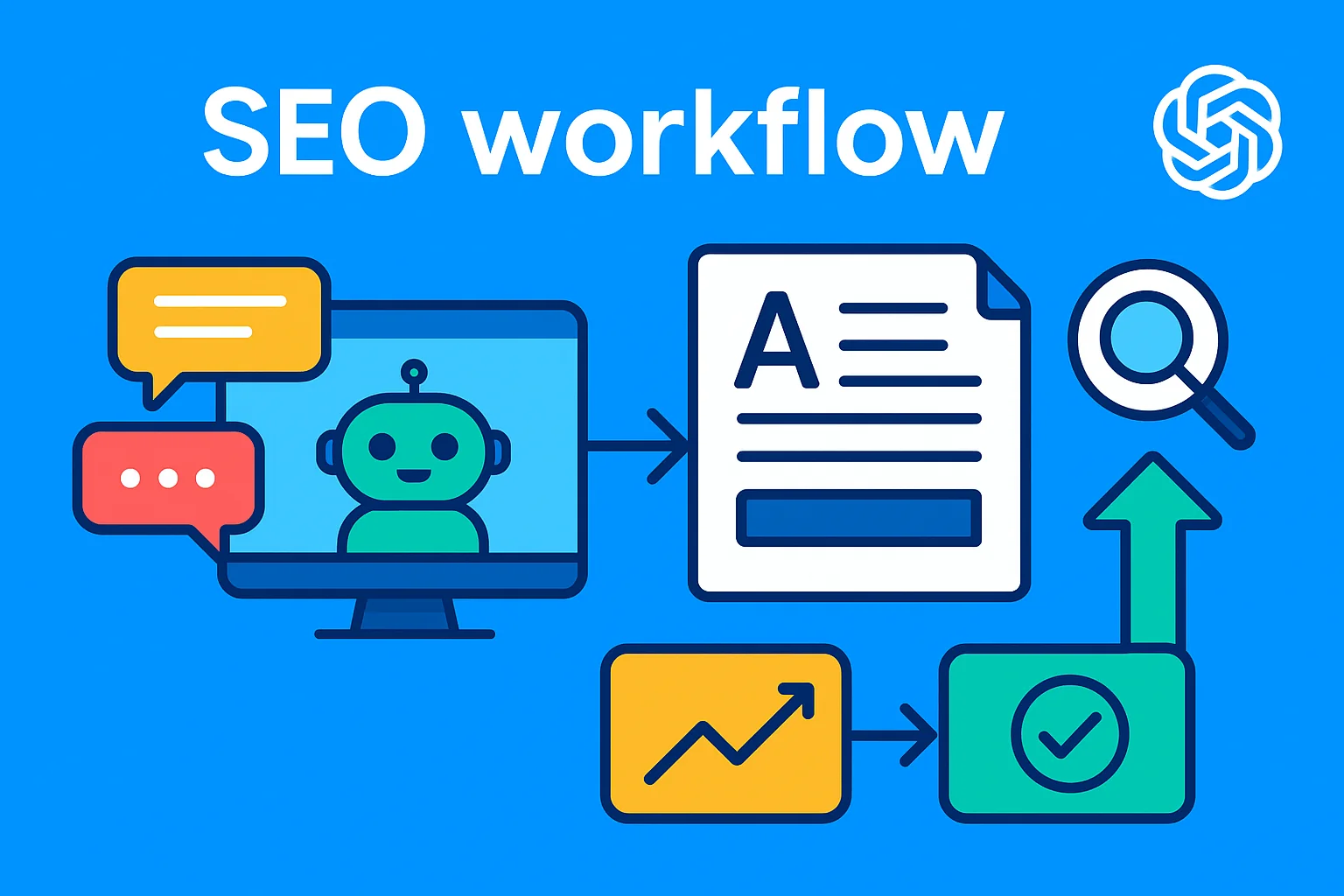
A structured seo workflow ai turns fragmented SEO tasks into a repeatable system that automates research, briefs, drafting, optimization, and publishing while enforcing brand and editorial rules. It lowers marginal content costs, improves consistency across brands, and closes the loop between performance data and content production.
- Codifies keyword strategy, intent, and content clusters into reusable workflows.
- Embeds tone, messaging, and legal guardrails so every draft stays on brand.
- Connects CMS, analytics, and internal linking rules to automate handoffs.
- Uses AI orchestration to choose models, manage prompts, and route work.
- Keeps humans focused on strategy, approvals, and expert judgment.
Teams can build custom stacks with tools like n8n or adopt platforms like Factor 6 for faster deployment, governance, and integrated workflows that scale SEO content operations.
If you need to scale publishing without losing quality, an seo workflow ai turns research and brand rules into repeatable pipelines that produce publish-ready content.
This guide explains why seo workflow ai changes content operations, where it adds the most value, and how modern teams organize people, data, and AI.
Learn how platforms handle brand inputs and automated linking on our features page, or start your free trial to test a seo workflow ai in your workspace.
Why SEO workflow AI matters for modern content teams
Modern content teams are expected to ship expert-level articles across multiple brands, channels, and markets with a fraction of the headcount they had a few years ago. A structured seo workflow ai lets them do that by turning messy, ad hoc processes into a single, predictable system that is built for scale.
The limits of manual SEO content workflows
Manual processes are the hidden cost of content programs. Teams spend cycles on repeated keyword pulls, inconsistent briefs, manual metadata, and late-stage SEO fixes that delay publishing and leak traffic.
An seo workflow ai reduces these handoffs by codifying research, query intent, and editorial rules before writing begins, so less time is wasted on rewrites and patchwork optimization.
- Fragmented research across spreadsheets and tools that duplicates effort.
- Variable briefs that produce inconsistent, off-brand drafts.
- Post-publication SEO work, like metadata and linking, done as an afterthought.
- No reliable way to trace which content process improvements drive ranking gains.
Those operational limits explain why teams adopt a seo workflow ai, to convert tribal knowledge into rules, reduce repetitive work, and make publishing predictable.
How AI changes the economics of content production
AI lowers marginal cost per article by automating research, outlines, drafting, and optimization, enabling teams to publish more without linearly increasing headcount. When paired with structured workflows, a seo workflow ai turns expertise into repeatable assets, shifting investment from individual articles to scalable content systems.
The result is not just more content, it is faster iteration. With a seo workflow ai you can experiment with headlines, templates, and internal linking at scale, then route performance data back into the workflow to improve briefs and prompts.
Why workflows beat one-off AI prompts
One-off prompts create noise because they lack consistent inputs. A single prompt does not capture audience intent, brand tone, editorial standards, or linking rules, so outputs vary and require heavy human editing.
A workflow-level approach to seo workflow ai standardizes inputs, enforces guardrails, and captures the step where research becomes a publishable brief. That repeatability is what lets teams scale publishing while keeping quality and SEO performance aligned.
What SEO workflow AI actually is (and is not)
A seo workflow ai is best understood as an end-to-end system that connects research, strategy, content creation, and publishing, not just another AI writing tool. It coordinates people, data, and models so every article follows the same high-performing playbook from brief to URL.
Instead of asking an assistant to write one article at a time, you are encoding your entire SEO content process into reusable steps. That shift is what separates a real workflow from ad hoc usage of SEO automation AI or generic text generators.
Definition: From SEO automation tools to SEO workflow AI
Traditional SEO automation tools focus on specific jobs, like rank tracking or backlink analysis, and they usually live in separate dashboards. They are powerful, but they do not know your editorial calendar, target personas, or brand rules.
A workflow-centric approach connects those tools with an AI layer that can interpret outputs, make decisions, then trigger the next task. For example, a report from Semrush can feed an AI brief generator, which then supplies structure and intent notes directly to your writers or drafting agents.
If you can document how a senior strategist runs keyword research, prioritizes topics, and shapes outlines, you can turn that into an AI SEO process that runs the same way every time. That is what elevates a simple automation into a seo workflow ai that mirrors your best people at scale.
What SEO workflow AI can automate in your content lifecycle
The highest impact use of SEO automation AI is removing repetitive steps that do not truly require human judgment. That includes translation of raw data into briefs, consistent application of on-page SEO rules, and packaging content for publishing across multiple CMSs.
Used well, the AI layer becomes a reliable junior teammate that never forgets a rule, from word count ranges to schema markup patterns. It also gives strategists more leverage, since one well-designed workflow can support dozens of writers or brand managers.
- Aggregating keyword research across tools, clustering topics, and mapping them to search intent.
- Producing structured briefs with headings, questions to answer, and clear optimization targets.
- Drafting first versions of copy that match the brief, including titles, descriptions, and FAQs.
- Running on-page SEO checks for structure, coverage of entities, and internal linking opportunities.
- Preparing content for publishing by formatting, inserting links, and pushing to your CMS through integrations.
These automations cover the majority of production effort, yet they are all guided by your documented process. The result is a seo workflow ai that quietly handles the busywork while humans focus on selecting the right topics and sharpening the narrative.
What still needs human judgment and expertise
No matter how advanced your N8n SEO workflow or custom agent becomes, you still need people to make the big calls. Humans decide which audiences matter most, how aggressive to be with positioning, and where legal or compliance review is required.
Subject matter experts should validate nuanced claims, add original frameworks, and contribute proprietary data. Editors protect brand reputation by catching subtle tone issues and ensuring your seo workflow ai does not over-simplify complex topics.
Teams that get the balance right treat AI as a force multiplier, not a replacement. They pair clear guardrails and checkpoints with documented standards, so human judgment shapes the work at the right time without bogging down the entire pipeline.
Core components of an effective SEO workflow AI
An effective seo workflow ai is built from four categories of inputs, strategy, brand, operations, and AI orchestration. When those inputs are explicit, not implied, your workflows become predictable, measurable, and easier to improve over time.
Think of it as building a content operating system. Strategic inputs tell the system what to target, brand inputs determine how you sound, operational inputs define where content lives, and the AI layer moves work from one step to the next.
Strategic inputs: Keywords, intent, and content clusters
Every workflow starts with a clear map of the topics and intents you care about. That means defined content pillars, target personas, and an understanding of how different queries fit into your funnel.
Instead of ad hoc keyword spreadsheets, feed your system with structured data from tools and your own performance metrics. Platforms like Factor 6 use data driven keyword ideas and deep SERP research to anchor workflows in reality, not guesses.
When you encode clusters, preferred angles, and internal competition rules, your seo workflow ai can allocate new opportunities intelligently. It knows which topics need net new articles versus internal updates or consolidation.
Brand inputs: Tone, messaging, and editorial standards
Publishing at scale only works if every piece still sounds like you. That requires codifying voice, messaging pillars, do and do not phrases, and examples of content that hit the mark.
Instead of a static style guide in a shared drive, embed these rules directly into your prompts and templates. With workspace-level controls, like those in Factor 6 brand workspaces, you can maintain distinct voices across multiple products or clients without rewriting every draft.
Editorial standards should cover depth expectations, claims handling, sourcing, and formatting. The clearer these are, the more your seo workflow ai can enforce them automatically and flag outliers for human review.
Operational inputs: CMS, analytics, and internal linking rules
Operational inputs are what let your workflows interact with the real stack your team uses. That includes CMS schemas, content types, URL patterns, and any custom fields you rely on for navigation or design.
To close the loop with performance, your workflows also need access to analytics and search data. This lets you trigger refreshes when rankings slip, impressions plateau, or conversion rates change for key articles.
Automated linking is a high leverage example. By embedding rules and using tools like automated internal linking, your seo workflow ai can keep site architecture healthy without manual spreadsheet audits.
Strong operational inputs, combined with flexible CMS integrations, turn content from a static output into a living system that responds to real user behavior.
AI orchestration: Models, prompts, and integrations
The orchestration layer is where raw models become a dependable system. It defines which model to use for which step, how prompts are structured, and what tools each step can call.
For example, you might use a smaller model to transform data into bullet summaries, and a larger one for voice-sensitive drafting. Clear prompt templates, versioned over time, keep behavior predictable across brands and campaigns.
Integrations connect these steps to your existing SEO suite, CMS, and communication tools. Platforms like Factor 6 abstract that complexity, so your team focuses on outcomes like content that ranks in Google rather than managing API calls.
Step-by-step SEO workflow AI design
Designing a seo workflow ai is less about writing clever prompts and more about mapping a clear process. Work through each step from business goals to review loops, and you will end up with a system that supports your team instead of fighting it.
The following steps mirror how high-performing content teams standardize their pipeline, from idea to URL. You can implement them with your existing tools, a platform like Factor 6, or a mix of automation builders and SEO suites.
1. Define goals, roles, and guardrails
Start by deciding what success looks like. Are you trying to double publishing volume, unlock a new topic cluster, improve conversion from existing traffic, or support more brands with the same team.
Once goals are clear, assign ownership. Define who sets strategy, who reviews AI outputs, and who owns final sign off. Guardrails should cover where AI is allowed to draft, what it can never change, and which steps always require a human touch.
2. Map your end-to-end SEO content workflow
Document your current process in detail, including every handoff and tool. For each stage, note inputs, outputs, owners, and typical bottlenecks.
Most teams discover they are running multiple hidden workflows, one for hero content, another for refreshes, and another for quick win posts. Aligning on a single, shared map is the foundation for an effective seo workflow ai, because it clarifies what you want AI to emulate.
3. Choose data sources, SEO tools, and AI stack
With the process mapped, decide which tools will power each part. This might include an SEO suite for research, analytics for performance data, and automation platforms like n8n or Gumloop for glue logic.
If you are building a N8n SEO workflow, be explicit about which APIs feed your N8n SEO agent and where N8n SEO automation stops in favor of human review. Otherwise you will recreate the same fragmentation you were trying to avoid, only with more complexity.
Teams that prefer a streamlined stack often consolidate research, content generation, and publishing in a dedicated platform, then connect it to their analytics stack. Articles like Factor 6's SEO automation guide can help clarify which jobs belong to which tools.
4. Design reusable prompts, briefs, and templates
Next, turn your best briefs and outlines into reusable assets. Capture how you describe target readers, how you structure introductions, and how you frame product mentions.
Create prompt templates for recurring tasks such as generating outlines from SERP data, writing meta descriptions, or proposing internal links. Over time, refine these templates based on what actually ranks, using insights from resources like how to use AI for SEO content creation.
5. Automate hand-offs between research, writing, and publishing
Hand offs are where most workflows break. Use automations to move structured outputs from one step to the next, for example, turning a finalized keyword cluster into briefs, then into CMS-ready drafts.
This might involve pushing data into project management tools, triggering notifications when a draft is ready, or auto populating CMS fields. A well-designed seo workflow ai feels like a single system, even if multiple tools support it behind the scenes.
6. Set up review loops, QA, and performance tracking
Finally, embed measurement into the workflow itself. Define how you check drafts for SEO coverage, factual accuracy, and brand tone before they leave the queue.
After publication, tie performance data back to specific workflows, prompts, or templates. That feedback loop lets you adjust guardrails, change model choices, or evolve your seo workflow ai design without guessing.
Practical SEO workflow AI examples for content teams
Theory is useful, but teams adopt new systems when they see concrete wins. These seo workflow ai examples show how to apply the principles to real publishing scenarios your team already manages.
Each example can stand alone or become a module inside a larger pipeline. Start with the use case that maps to your highest leverage opportunity, whether that is net new content, refreshes, or coordinating multiple brands.
A reusable SEO workflow AI template for blog articles
A common starting point is a standard seo workflow ai template for long form blog posts. It takes a prioritized keyword, runs structured SERP analysis, generates a brief, and creates a draft aligned to your brand voice.
From there, the workflow checks for topical coverage, applies internal linking rules, and prepares a formatted version ready for your CMS. Because every article passes through the same steps, you get consistent quality and reliable measurement.
Refreshing and expanding existing content at scale
Another high impact pattern is a workflow for content refreshes. It monitors rankings and traffic, identifies pages losing momentum, and builds targeted update briefs.
The AI layer can compare your article with current competitors, surface gaps, and suggest new sections or entities to cover. You retain control over the final narrative, but your team no longer spends hours manually auditing each URL.
Launching SEO content for new products or features
When you launch a new product, you need coverage that spans value propositions, use cases, comparisons, and how to content. A dedicated workflow can turn a product brief into a coordinated set of SEO pages and articles.
By feeding in positioning docs, messaging frameworks, and target personas, the system proposes topics, outlines, and launch-ready drafts. This lets marketing keep pace with product shipping velocity without sacrificing depth or consistency.
Running multi-brand or agency SEO workflows with AI
Agencies and multi brand SaaS teams need to juggle different voices, strategies, and approval rules. A single seo workflow ai can support all of them if it is organized around brand-specific workspaces and inputs.
In a setup like Factor 6, each workspace carries its own tone, guidelines, and linking rules, so the same workflow template behaves differently per brand. That structure is what allows a small central team to run a large portfolio without content starting to feel interchangeable.
How SEO workflow AI fits with existing SEO automation tools
Most teams searching for seo workflow ai are not starting from scratch, they already use SEO automation tools for research, tracking, and audits. The goal is to connect those tools with AI so work flows from insight to published content without manual copying.
Think of your current stack as a set of data sources and checks. The workflow layer sits on top, interprets that data, and decides what to create or update next, while still letting each specialized tool do what it does best.
Where traditional SEO automation tools still shine
SEO suites and point solutions remain essential for visibility into your market and technical health. They are built to monitor changes over time, surface issues, and provide structured exports that AI can interpret.
Trying to replace them entirely with language models usually results in blind spots and unreliable measurements. Instead, use them as reliable sensors and sources of truth, and let your workflow AI handle interpretation and content execution.
- Keyword discovery, difficulty estimation, and SERP feature tracking at scale.
- Site audits for technical issues, broken links, and performance problems.
- Backlink monitoring and competitive gap analysis across domains.
- Rank tracking for key terms, segments, and markets over time.
By keeping these jobs in specialized SEO automation tools, your seo workflow ai can focus on turning insights into prioritized briefs and drafts instead of recreating raw data collection.
What only a workflow-level AI layer can do
Workflow-level AI adds the connective tissue between tools and teams. It can read reports, decide which actions matter, and initiate work across multiple systems without waiting for a human to triage everything.
For example, when rankings for a money page drop, your workflow can pull fresh SERP data, compare content, generate an update brief, and notify the owner. No single free SEO automation tool does all of this in context, but a well-designed workflow can.
This is also where brand and process knowledge live. Your seo workflow ai remembers past experiments, preferred angles, and internal priorities, so it proposes work that aligns with your actual strategy, not generic best practices.
Integrating platforms like Semrush, n8n, and Gumloop
Integration patterns vary by team, but the principle is the same. Use tools like Semrush for data, automation platforms like n8n or Gumloop for routing, and a content platform to enforce brand and SEO standards.
Your N8n SEO workflow might orchestrate APIs and schedule runs, while a dedicated content layer like Factor 6 turns that information into briefs and drafts. Gumloop flows can handle bespoke enrichment or reporting tasks that plug into the same pipeline.
Over time, you want fewer ad hoc scripts and more reusable workflows documented in one place. A central platform, connected through flexible integrations, helps keep your seo workflow ai understandable even as it grows more capable.
Governance and quality: Keeping your workflow AI on-brand
Scaling with AI only works if quality remains high. Governance ensures that your seo workflow ai respects brand guidelines, legal requirements, and editorial standards while still delivering speed.
This is not about creating bureaucracy, it is about designing clear checkpoints and responsibilities so nobody wonders whether an AI generated draft is safe to publish.
Designing approval flows and human-in-the-loop review
Begin by mapping which content types require which approvals. Product pages, legal sensitive topics, and thought leadership might all need different reviewers and stricter criteria.
Then, embed those rules into your workflow. For example, drafts on sensitive topics always route to a specific editor, while low risk refreshes can be batch reviewed. The goal is to focus human attention where it matters most.
With the right setup, your seo workflow ai becomes a structured queue of work, not a stream of unmanaged drafts. Reviewers see context, briefs, and AI reasoning, which makes final decisions faster and more consistent.
Maintaining brand consistency across multiple workspaces
Brand drift is a real risk when multiple teams, agencies, or freelancers are involved. Workspaces with dedicated guidelines, examples, and do and do not rules help preserve each brand's identity.
Tools like Factor 6's on brand content workspaces make these constraints part of the workflow itself. Writers and AI agents operate within the same parameters, so outputs stay aligned even as people change.
For multi brand organizations, this setup lets a single seo workflow ai serve multiple audiences without mixing voices. Each workspace can share structural logic, like how briefs are built, while keeping language and positioning distinct.
Monitoring SEO performance and evolving the workflow
Governance is not only about prevention, it is also about learning. Tie workflow performance to SEO outcomes like rankings, traffic, and assisted conversions, and review results regularly.
When specific templates or prompts consistently outperform others, standardize around them. When performance drops, investigate whether the issue is strategy, execution, or changes in search behavior.
Resources such as the Factor 6 SEO blog can inform these updates, keeping your practices aligned with how search and LLMs evolve. Over time, your governance model becomes a competitive advantage rather than a constraint.
Build or buy: Custom SEO workflow AI vs platforms like Factor 6
Once you understand what is possible, the next question is whether to assemble your own stack or use a dedicated platform. The right choice depends on your technical capacity, complexity, and how quickly you need a working seo workflow ai in production.
Both paths can succeed if you are clear about trade offs, cost of maintenance, and the value of opinionated workflows. The sections below outline when each approach makes sense and what to watch for when evaluating solutions.
When to build your own SEO workflow AI stack
Building your own stack can be attractive if you have strong internal engineering or operations teams and highly specific needs. It lets you tailor every step, from how you hit APIs to how you store intermediate artifacts.
This route may involve wiring together SEO suites, custom databases, automation tools like n8n, and LLM providers. Over time, you will need to maintain these scripts, monitor API changes, and ensure that your seo workflow ai still aligns with evolving brand rules.
Teams that succeed with custom builds usually treat them as products, with roadmaps, owners, and documentation. Without that discipline, the system can quickly become a fragile collection of one off automations.
When a platform like Factor 6 is the faster path
If your priority is speed to value and predictable outcomes, a dedicated platform is often better. It offers proven workflows, governance features, and integrations out of the box, so your team can focus on strategy and content.
Factor 6, for example, is an AI SEO content tool for brands and agencies that turns research, brand inputs, and performance data into publish ready articles. Instead of stitching together tools, you configure workspaces, review outputs, and iterate on your approach.
Pricing is transparent, with options sized for growing teams, so you can compare it directly against the hidden cost of internal engineering time. Exploring the Factor 6 pricing plans is a straightforward way to benchmark build versus buy economics.
Key criteria for evaluating any SEO workflow AI solution
Whether you build or buy, evaluating solutions against consistent criteria helps avoid surprises. Focus on how each option will perform in the messy reality of your content operations, not just in a demo.
Look for evidence that the workflows can handle your volume, complexity, and governance needs today, with room to grow as your program matures.
- Quality and consistency of outputs, including examples of content that ranks for competitive terms.
- Depth of brand controls, from tone and messaging to legal and compliance options.
- Integration flexibility with your CMS, analytics, and preferred SEO automation tools.
- Transparency around data handling, permissions, and change management.
- Support, documentation, and roadmap visibility so your seo workflow ai improves over time.
By scoring each option against these points, you can choose the approach that delivers durable leverage, not just short term novelty. The right system will feel like a natural extension of your team, not another platform to fight with.
Talk to Factor 6 about scaling your SEO workflow AI
Factor 6 helps agencies, SaaS teams, and multi-brand organizations move from one-off prompts and scattered automations to a repeatable, measurable seo workflow ai that publishes expert-level content. We map your keyword strategy, brand workspaces, editorial guardrails, and CMS integrations into a single pipeline that automates research, outlines, drafting, internal linking, and publishing, while keeping human review where it matters. See how our platform enforces brand consistency with workspaces and automated internal linking, explore data-driven keyword ideas and SERP research on the features page, or try a hands-on demo to evaluate a reusable seo workflow ai template for your team.
Conclusion, a production-ready seo workflow ai turns fragmented SEO tasks into a scalable system that delivers publish-ready, on-brand content faster, drives measurable organic growth, and reduces the manual work that slows teams down. Whether you need a custom SEO automation AI pipeline, an SEO workflow AI template to run refreshes at scale, or help integrating tools like n8n and your CMS, Factor 6 is built to preserve expertise while accelerating publishing. Contact the Factor 6 team to discuss a pilot, demo, or the best path to scale your seo workflow ai.
FAQs
What is an SEO workflow AI?
How does a workflow-level approach differ from one-off AI prompts?
Which content tasks can SEO workflow AI automate?
What still requires human judgment despite automation?
Should we build a custom SEO workflow AI stack or use a platform like Factor 6?
Wout Blockx
CTO of FACTOR 6, focussed on creating a platform to help businesses expand their organic visibility.
Get started with a free trial
Start creating expert, on-brand content within minutes.
More related blogs
Automated keyword research with AI: fast discovery and intent mapping
Automate keyword research with AI to find high-intent topics, map search intent, and scale SEO content. Learn workflows B2B teams use with Factor 6.
How to build an ai content workflow that scales and stays accurate
Learn how to design an AI content workflow that scales, protects brand voice, and keeps SEO accuracy high across blogs, landing pages, and more.

Does Google penalize AI content? what the experiments say
See how Google treats AI-generated content in 2025. Learn the policies, real experiment results, and how to use AI for SEO without spam risks.